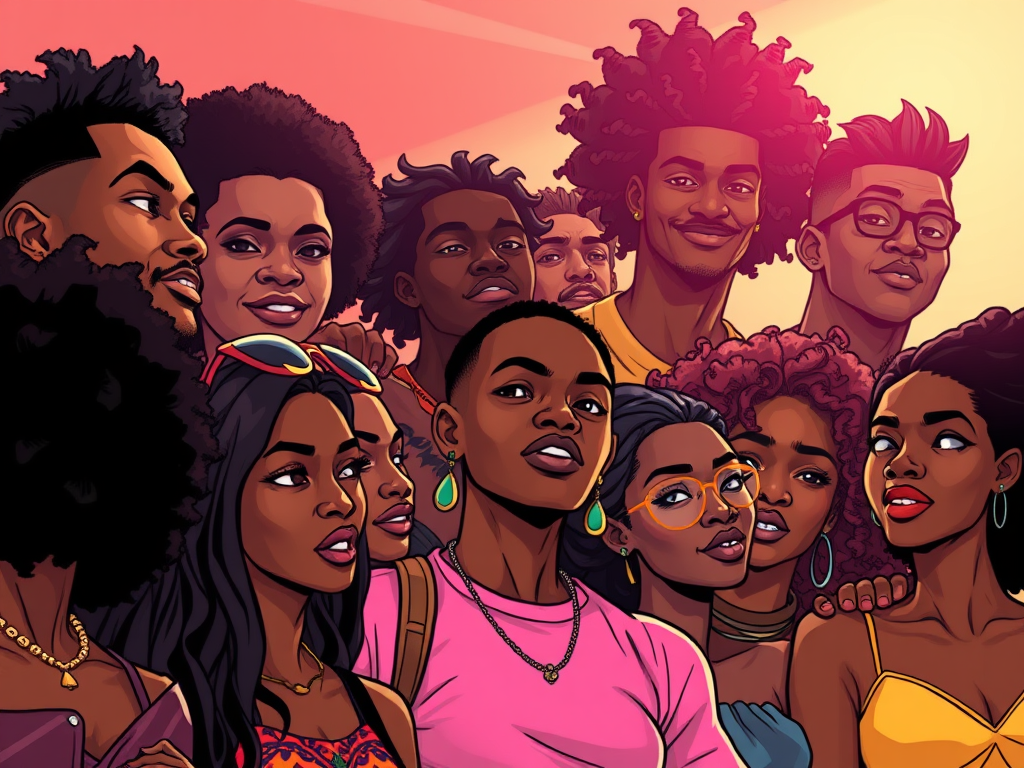
The fight for Black liberation has always been a fight against racism at its core. From slavery to segregation to today’s forms of mass incarceration and systemic inequity, racism has been the consistent force attempting to control, silence, and diminish Black life. But racism does not act alone. It adapts, attaching itself to other systems of oppression; gender norms, sexual regulation, and class hierarchies that divide our communities and weaken our collective resistance. This is where Black queer politics comes in. Not as a separate revolution, not as the single center of liberation, but as an essential ally in the larger struggle. Understanding the dual issue of racism and queer oppression means seeing how Black queer experiences reflect, complicate, and extend the fight against racism. To ignore one while fighting the other is to risk building a freedom that leaves people behind.
Audre Lorde, in Sister Outsider, warns us that “your silence will not protect you.” She reminds us that differences whether of sexuality, gender, or identity cannot be erased in the name of unity. For Lorde, allyship requires facing those differences honestly and embracing them as sources of strength. This is the work of Black queer politics as allyship: not demanding that the racial justice movement become “queer-centered,” but refusing to let queer Black voices be silenced within it. Racism cannot be dismantled if it is only challenged through the lens of heterosexual respectability. By standing alongside Black queer struggles, the broader anti-racist movement learns to fight with greater honesty, refusing the silence that has too often fractured liberation efforts.
Jerald Podair’s Bayard Rustin: American Dreamer reminds us of what happens when allyship falters. Rustin an unapologetic gay Black man was one of the sharpest strategists of the civil rights movement, the organizer behind the 1963 March on Washington. Yet, because of his sexuality, he was pushed to the margins. His queerness was used as a weapon against him, and even those he worked alongside allowed that erasure to happen. What Rustin’s story exemplifies is that racism and homophobia are never entirely separate battles. They intersect in ways that, if ignored, weaken the fight against racism itself. Rustin’s vision of freedom was expansive connecting civil rights to labor rights, to global anti-colonial struggles. But the movement’s inability to fully embrace him reflected a missed opportunity: the failure to see queer allyship as part of the same fight.
Robin D. G. Kelley in Freedom Dreams: The Black Radical Imagination urges us to dream bigger than survival. Movements require imagination and visions of freedom that extend beyond current systems. Here, allyship between racial justice and queer politics becomes powerful. Black queer communities have long had to imagine alternative kinship, love, and survival outside of state-sanctioned structures. These practices don’t shift the center of the anti-racist struggle but enrich it, showing new possibilities of freedom that benefit all Black people. The point is not that queer politics should redefine Black liberation. The point is that without queer allyship, our collective imagination is smaller, narrower, and less equipped to dismantle the full reach of racism.
Patricia Hill Collins, in “Prisons for Our Bodies, Closets for Our Minds: Racism, Heterosexism, and Black Sexuality,” explains that racism in the twenty-first century operates through gender and sexuality just as much as through law and policy. The “new racism” reinforces old hierarchies by demanding “respectability” from Black communities while punishing those who fall outside the narrow box of heterosexual, patriarchal norms. Collins reminds us that Black liberation cannot be achieved through assimilation into dominant norms. The myth of respectability promises acceptance if we act “properly” if our families look traditional, if our bodies are disciplined, if our sexuality remains invisible. But this promise is shallow. The same structures that exploit and police queer Black people also criminalize and marginalize Blackness as a whole. Thus, allyship between anti-racist and Black queer movements is not optional it is strategic. By confronting how racism weaponizes gender and sexuality, we expose its full machinery. Collins’s analysis forces us to see that freedom must be both racial and sexual. Otherwise, we only dismantle part of the cage.
If the Black freedom struggle has a weakness, it has often been internal division over class, gender, sexuality, or ideology. But as Lorde, Rustin, Kelley, and Collins all show, these differences are not the enemy; our refusal to confront them is. Allyship demands that we move past the false idea that unity requires sameness. True solidarity comes from shared purpose and mutual recognition, not uniform identity. Black queer politics, positioned as allyship rather than as a competing revolution, calls the broader community to accountability and expansion. It insists that anti-racist movements look inward as well as outward, ensuring that the liberation we seek externally is also practiced internally. When heterosexual Black activists stand in solidarity with Black queer communities, they challenge racism’s divide and conquer strategy. When queer activists align their struggles with the broader fight against racism, they amplify the call for justice that encompasses all forms of oppression.
This reciprocal relationship strengthens both movements. Allyship here is not charity it’s coalition. It recognizes that the systems targeting queer Black people and those targeting Black communities more broadly share roots in the same ideology of white supremacy. Fighting one without the other leaves the structure intact. Allyship between racial justice and Black queer politics requires ongoing work. It means addressing homophobia and transphobia within Black communities but also challenging racism within queer spaces. Too often, LGBTQ+ advocacy centers white experiences, sidelining the racialized realities of queer Black life. Effective allyship must confront both dynamics simultaneously.
This work also involves education and cultural transformation. As Collins reminds us, the new racism thrives on controlling images and stereotypes that shape how we see ourselves and one another. Breaking those images demands visibility, storytelling, and community-building. It means lifting-up figures like Rustin, celebrating thinkers like Lorde, and embodying Kelley’s radical imagination in practice. Most importantly, it means redefining what liberation looks like. A freedom that only benefits some Black people is not freedom at all. True allyship pushes us toward an expansive vision where everyone, regardless of sexuality or gender, can live without fear, shame, or silence. The struggle against racism remains at the heart of Black liberation. But to win that fight, we must confront all the forces that sustain it. Black queer politics, when embraced as allyship, offers both critique and creative power. It reminds us that liberation is not just about equality under existing structures it’s about transforming the conditions that made those structures necessary in the first place.
Audre Lorde teaches us that silence is complicity. Bayard Rustin shows us the cost of exclusion. Robin D. G. Kelley gives us the courage to dream beyond the limits of what is, and Patricia Hill Collins reminds us that oppression is never singular. Together, their work points to a shared truth: the fight against racism and the fight for queer inclusion are not competing agendas but interconnected paths toward a deeper, more honest freedom. To engage in this allyship is to refuse the false choice between racial justice and queer liberation. It is to believe that freedom, if it does not include all of us, is not freedom at all.
WORKS CITED
Collins, Patricia Hill. “Prisons for Our Bodies, Closets for Our Minds: Racism, Heterosexism, and Black Sexuality.” In Black Sexual Politics: African Americans, Gender, and the New Racism, 49–78. New York: Routledge, 2004.
Kelley, Robin D. G. Freedom Dreams: The Black Radical Imagination. Boston: Beacon Press, 2002.
Lorde, Audre. Sister Outsider: Essays and Speeches. Berkeley: Crossing Press, 1984.
Podair, Jerald E. Bayard Rustin: American Dreamer. Oxford: Oxford University Press, 2009.
 Race, Gender, Politics, & Other Shit...